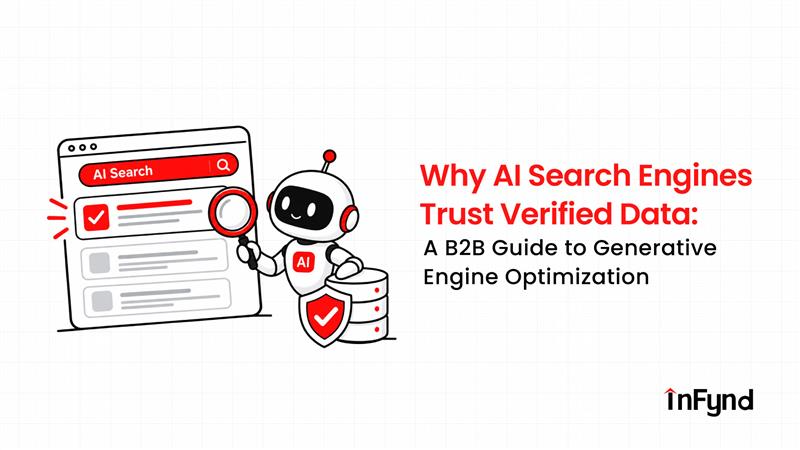
B2B buyers increasingly ask ChatGPT, Perplexity, and Google AI Overviews to shortlist vendors before they ever open a traditional search results page. That shift has created a new discipline, Generative Engine Optimization (GEO) and at the center of it sits one technical reality most marketers overlook: AI engines don't rank pages, they select sources to trust.
What Makes an AI Engine "Trust" a Source
Generative engines work through retrieval-augmented generation (RAG) or live retrieval layers that pull candidate content, then synthesize an answer. During that process, the model isn't just matching keywords, it's weighing signals of reliability: does the content contain specific, verifiable claims, or vague generalizations?
This is where verified data becomes a direct GEO advantage. Content built on accurate, current, sourced information, real statistics, named data points, and precise figures is structurally easier for a language model to extract and cite with confidence. Vague marketing copy ("many companies report success") gives the model nothing concrete to attribute. A specific figure, correctly sourced, gives it something citable.
GEO vs. Traditional SEO: The Core Technical Difference
Traditional SEO optimizes for ranking signals, backlinks, keyword density, page speed, domain authority, to win a position in a results list. GEO optimizes for citation probability, whether a generative model selects your content as source material for its synthesized answer. The mechanics differ:
• SEO: Rewards authority accumulated over time (backlink profiles, domain age).
• GEO: Rewards clarity and verifiability at the content level; often independent of domain authority, a well-structured, data-backed page can get cited even from a newer domain if the underlying claims are accurate and well-sourced.
• SEO: Is largely static between crawl cycles.
• GEO: Performance can shift as engines re-retrieve and re-weight sources, especially on platforms using live retrieval like Perplexity and AI Overviews.
How to Structure Content AI Engines Can Actually Cite
1. Lead with verifiable claims: State a specific number, date, or fact early in each section; models extract concrete data points far more reliably than qualitative statements.
2. Use clear, declarative sentence structure: Complex, marketing-tone sentences are harder for extraction models to parse cleanly into a citable statement.
3. Add structured data: Schema markup (article, FAQ) still helps machine parsing; even though Google's visible FAQ-rich-result snippet was deprecated, the underlying structured signal still supports AI comprehension.
4. Keep source data current: Retrieval-based engines can reflect updated content within weeks; stale statistics reduce citation confidence over time.
5. Build authority beyond your own domain: LinkedIn posts, forum answers, and third-party mentions increasingly feed what generative engines treat as corroborating evidence for a claim.
Why This Matters More for Data-Driven B2B Brands
Any company can write about a trend. Far fewer can back claims with first-party verified data and that gap is exactly what separates content that gets cited from content that gets ignored by generative engines. A brand whose core business is data accuracy has a structural advantage in GEO that a generic content marketing team doesn't: the claims are already sourced, because sourcing is the product.
Final Thoughts
GEO isn't a marketing trick, it's a technical filtering problem, and verified, well-structured data is what wins it. Brands built around data accuracy aren't just better positioned to write about GEO; they're structurally better positioned to win at it.
Where InFynd Fits
At InFynd verified data isn't a talking point, it's the actual product. Every claim we make about our B2B data intelligence platform is backed by the same accuracy standard GEO rewards: sourced, current, and specific.
As go-to-market teams think about how AI engines evaluate their content, 27x.ai InFynd's AI agent platform, currently in development is being built around this same principle: automation grounded in verified data, not generic output. Explore InFynd's data enrichment tools or read more insights on our blog
FAQ
Does GEO replace SEO?
No, GEO builds on SEO fundamentals; strong technical SEO remains the foundation generative engines still partly rely on.
Why does data accuracy matter more in GEO than SEO?
Because generative engines synthesize and attribute claims directly, inaccurate or vague content is filtered out at the source-selection stage, before ranking even applies.
How fast can GEO results show up?
Engines with live retrieval (Perplexity, AI Overviews) can reflect changes within weeks; others operate on longer training cycles.