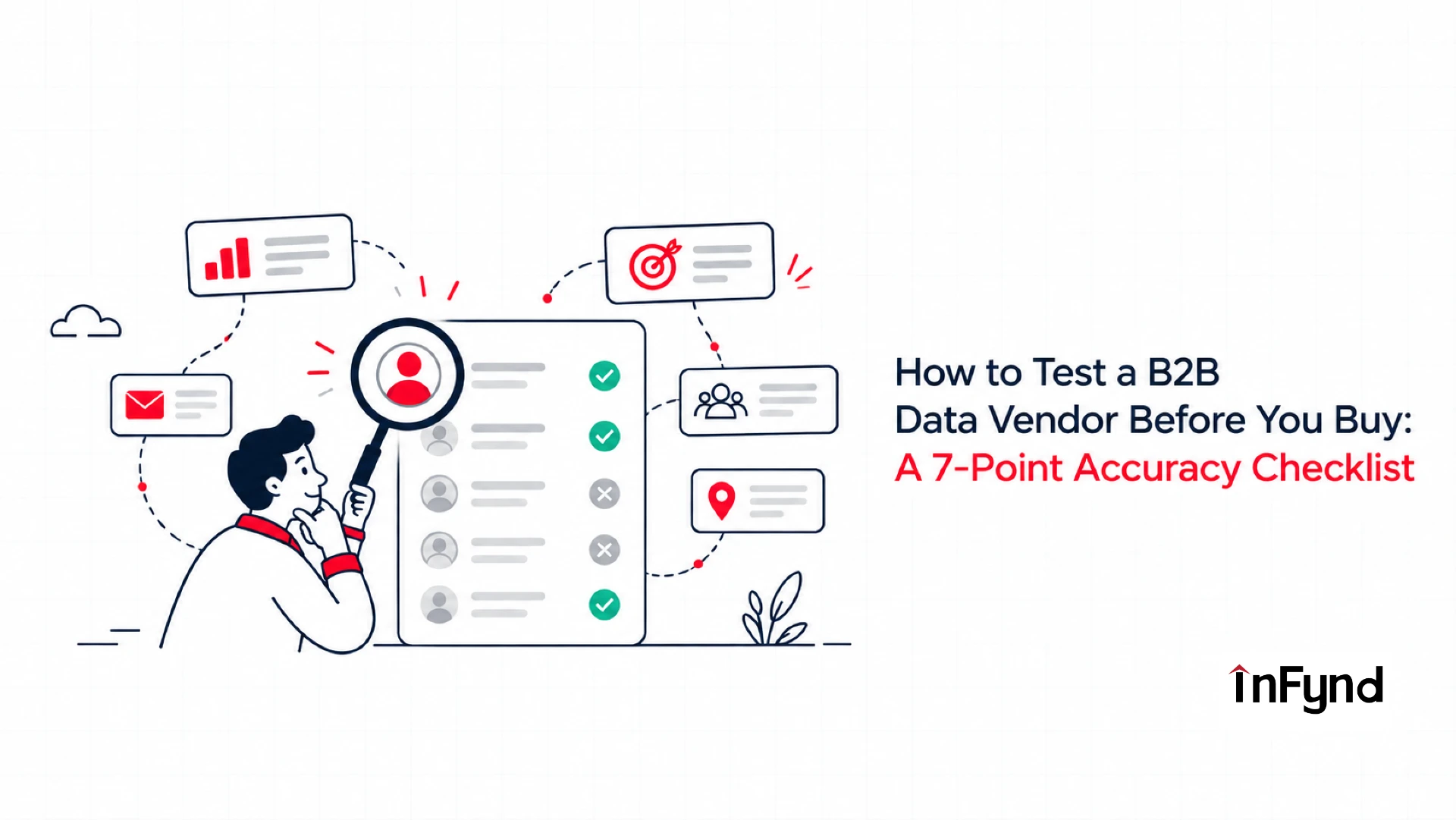
Every B2B data provider claims high accuracy. Few prove it. Before you commit budget to a database, you need a repeatable way to separate verified data from a big list that only looks impressive. Poor data quietly damages lead generation: emails bounce, reps call the wrong people, and sender reputation drops.
This 7-point checklist gives you a practical data vendor evaluation process you can run in a week, before you sign anything.
Why Testing Beats Trusting the Sales Deck
Accuracy figures in a pitch are usually self-reported and measured on the vendor's best records. Your results depend on your target market. A provider that is excellent for US software companies may be weak for European manufacturers or healthcare professionals. The only reliable evidence is a test on your own sample.
The 7-Point Accuracy Checklist
1. Run an email accuracy test on your own sample
Ask for a sample of contacts matching your ideal customer profile, then validate every email address with an independent verification tool. Track the bounce rate and the share of invalid or risky addresses. Never evaluate on a sample the vendor selected for you.
2. Ask how records are verified, and how often
"Verified" should mean a documented process, not a marketing label. Ask what checks are applied, whether verification is automated or manual, and how frequently records are refreshed. B2B data decays as people change jobs, so a dataset checked once a year is already partly stale.
3. Measure coverage against your actual market
Compare the vendor's database with a list of accounts you already know. How many of your target companies appear? How many of the right roles per account? Coverage gaps in your specific region, industry or seniority level matter more than total record counts.
4. Confirm where the data comes from
Ask about sourcing and chain of custody. Compliant B2B data comes from documented, auditable sources, not unverifiable scraping. Check GDPR and other privacy compliance, because the legal risk of poor sourcing falls on the buyer as well as the seller.
5. Check the depth of enrichment
A contact with only a name and email is a starting point, not a lead. Look at how complete the key fields are: job title, department, seniority, company size, industry, and location. Incomplete fields limit segmentation and personalization.
6. Match the sample against your CRM
Upload the sample against your existing records. Check the overlap, the duplicates, and how many contacts are net-new. A strong provider should add value to your CRM rather than repeat what you already hold, and should help you correct outdated records.
7. Test flexibility, integration and support
Can the vendor build a custom dataset around your requirements, or only sell fixed lists? Does the data integrate with your CRM and sales tools? How quickly does support respond when you find an error? Accuracy problems are inevitable at scale, so the response process matters.
How to Score Your Vendors
Score each vendor from 1 to 5 on every point and compare totals. Weight the points that matter most to your team: a sales team focused on cold email should weight email accuracy heavily, while a regulated industry should weight sourcing and compliance first. Avoid choosing on price alone, since cheap data that bounces costs more in wasted effort than accurate data costs to buy.
Why InFynd Is Built to Pass All Seven Tests
At InFynd, we believe we are among the best B2B data providers you can choose, because our approach is built around exactly these seven checks. Our B2B data intelligence platform is designed around verified contacts and company intelligence. Our data enrichment tools add depth and help correct outdated CRM records. We build custom datasets around your ideal customer profile, and we source data with compliance in mind. For healthcare teams, InFynd Healthcare applies the same standard to HCP data.
FAQ
What is a good email accuracy rate for a B2B data provider?
Aim for a low bounce rate on your own tested sample. Ask each vendor what they guarantee and how they handle bounces above that level.
How big should my test sample be?
A few hundred contacts matching your ideal customer profile usually shows clear patterns, while a sample of only a few dozen can mislead.
How often should B2B data be refreshed?
Regularly and continuously where possible, because contacts change roles frequently and records decay month by month.
Is a bigger database always better?
No. Coverage of your target market and the accuracy of each record matter more than total size.
What should I ask a vendor about compliance?
Ask where the data is sourced, how consent or legitimate interest is handled, and how they support GDPR and similar regulations.